Wednesday, February 6, 2013

China, Gangnam Style


Our tour guide, William, has kept us on our toes in Xi'an.  We never know quite what's coming next, but we can be sure it will be fun.

William, who is also known to his family and dear friends as Borbor, is the only boy in a family of four, and (self declared) very spoiled.  His parents had two daughters before the one family, one child policy was instituted, and they paid a substantial fine to have a third child, who turned out to be Borbor and his twin sister.  He's a hip 30-something with a sly sense of humor, and an outrageous flirt.

We had not been on the tour bus for five minutes before William told us that he had been on stage the week before dancing to Gangnam Style in front of an audience of 1000 coworkers and their families at the annual New Year's office party.  He pulled out his cell phone and we watched the video as we traveled from the airport to the city.  (If you have not seen Gangnam Style or any of its knock-offs, check them out on Youtube.)

William took lead, with several back-up dancers, and we all agreed he was very good.  It did not take much convincing for him to agree to dance for us the next day.  Meanwhile, at every stop we made, we saw William showing the video to anyone and everyone.

(His phone gets quite a workout.  In addition to its use for Gangnam Style, he makes and receives calls constantly.  Xi'an is a small city, he says, only 8 million people, but I think he got calls from every one of them.)

Our first stop the next day was the terra cotta warriors museum, and William was as good as his word.  After lunch, as we were gathering the group to go back to the bus, we did an impromptu performance, with William leading about ten of the group, many of whom were unfamiliar with the meme.  The results were hilarious—a group of Westerners stumbling through Gangnam Style as if it were an exercise class.  We ran through it twice, gathering a little crowd of puzzled onlookers.

Our next step was the orphanage, more accurately a foster care facility for children whose parents are in prison.   We were treated to a sweet little performance of a folk dance by the children, and then they invited us to perform for them.  With William's encouragement, the group from SAS and the children got up together and tried gamely to follow him.  (If this video is ever posted, you will see what a good sport I am, considering how bad I am at the routine.)

Then, the sweet little children went back up on the stage and performed their own version of Gangnam Style, perfectly choreographed and executed.

We'd been had, by a bunch of wide-eyed ringers.

More on Asakusa

(Blog posts out of order:  this one is from Jan. 29)


I did a lot of poking around stores, and found stores of all kinds.  I found a store that sells nothing but brushes, which I thought was unique until I found another one a few blocks away.  All kinds of brushes!  Brushes so soft they feel like fur and brushes so stiff you can scrub your tub with them.  Toothbrushes, hair brushes, mushroom brushes, basting brushes, paint brushes for artists and house painters alike.  Brooms, too:  brooms for sweeping the floor, or the desk, or the table, or the workbench.  I saw brushes that were nothing but bristles tied together, so they were brushes on each end.  Utilitarian brushes and fancy ones.  No combs, though.  And no brushes with plastic or metal bristles.  All of these brushes were wood and hair of some sort.

I did not buy a brush.  I also did not buy a handkerchief, although I found a store (in Roppongi Hills) that sells nothing but hankies.  They were displayed like fine jewelry and they cost almost as much.  Several very serious salespeople sat behind counters, consulting with customers about their handkerchief needs.  Or their handkerchief dreams, I suppose, because no one's nose needs this kind of treatment.  I was dressed far too casually to venture past the doorway, but I did see one hanky with a gem attached.  I'm hoping it was a rhinestone, but I doubt it.  And I saw a whole set of very playful hankies with dogs and cats embroidered on them.  Each animal was distorting the edge of a hanky with its teeth or paws.  Apart from those two, however, they were just really expensive handkerchiefs.  The cheapest one I saw was $21.

Prices in general did not always make sense to me.  I saw tights for $40 next to purses for $10.  Prices for kimono ranged from $10 to $700, with nothing I could see to justify such a great difference.  The $10 one is very tempting, until you try to figure out why they would let it go so cheap.  It is this kind of thinking that kept me shopping and not buying. 

I found one store I would have liked to get back to, which had a great variety of things made from fabric.  There were drawstring bags in several sizes, squares and rectangles for display as wall hangings or to twist up into bags and wrappers (lots of beautiful examples on display).  Baby washcloths, coin purses, and my favorite, a 1x2 inch fabric covered mirror and toothpick set.  Four carved toothpicks you can carry in your purse just in case you get a bit of seaweed stuck between your teeth.  Now that's practical elegance!  Sadly, I did not retrace that part of my route, and never saw that nice a selection of fabrics again.

One thing I did not find was stores with an extensive selection of papers, school supplies, or toys.  I'm pretty sure Japan does not import all its Hello Kitty items to the United States, but I didn't see anything worth carting back for my granddaughters.  I also didn't find any clothing or household items with hilariously bad English.  There was plenty of awkward English, and phrases that didn't make any sense, but nothing truly memorable.

At one point I got turned around and stumbled onto a whole district of wholesale shops for restaurants and stores.  Whole walls full of menus, or napkins, or sauce dishes.  I don't know why those appeal to me, but they do.  I particularly like the stainless steel ware, in all sizes and shapes.  (Except for 8" round with straight sides, a cake pan I would actually buy.)  My only purchase of the day (besides food) was a set of chopstick holders for Yoshiko and Kaji, red cherries to go with their red kitchen. 
Asakusa is near the point on the river where tour boats take off, and there's a very different atmosphere at that point.  All the people you see are tourists, and you can tell.  They walk more slowly, they're carrying different kinds of bags, and they wear different clothes.  And, there are more people asking for money on the streets.

Near the boat ride, there's a brewery with a sculpture that is described as "a golden object" on top.  I don't know what it's supposed to represent.  It looks like it was left there by a giant golden dog.  It's distinctive, but I really think it's ugly.

My last day in Tokyo, I visited the "fabric street," where there is shop after shop of fabric.  If I had been able to use my credit card, I probably would have bought some, just to have a souvenir from Tokyo, but I am running out of money with one day left.  When I got money from the ATM, the minimum was $100 and I spent almost $40 on the extra night with Yoshiko.  Most of the rest has been spent on subways.  So I don't think I have another $100 of spending (or places to spend it).  So it was more look but don't buy for me.  Good thing.  I have already filled up the suitcases I brought, with no interest in paying extra baggage on the way home.

Bless the babies!


My last day in Japan, I went to Kyoto on an SAS tour.  Kyoto is about an hour away from Kobe, on a highway with little to see.  Highways in Japan are even uglier than highways in the US.  They are very narrow and have walls so you can't see anything but the highway.  Kind of like a neverending bridge.

The days are going by so fast that everything is kind of a blur.  Our Kyoto trip covered the Imperial Palace, the Golden Pavilion, some lovely gardens and the shrine of good water.

We had a very short lunch break, which I spent looking for interesting stores to spend my last few yen.  Like a kid on an elementary school field trip, I was determined to spend every cent I had.  I was down to about ¥700, which is something under $7, so I headed to a convenience store to buy some yogurt and maybe some fruit.  (Through diligent effort, I left Japan with ¥4 in my pocket, my last purchase a can of Coke Zero from a vending machine.)

On the way, I passed a shrine and decided to go in.  Everyone was up the hill, so I had the place to myself.  It was unlike any of the other shrines I visited, and none of the signs had English, so I can't tell whether it was a religious difference or a regional one.  One of the shrines caught my eye with its masses of baby bibs.  Most of the bibs had writing and text on them, which I assumed was the baby's birth date and a blessing or good wishes for the baby's life. 


I found it touching, especially the little doll who watched over the bibs—and presumably the babies.

Our guide said, "Shinto is for the happy things, like weddings, and babies, and children becoming adults.  Buddhism is for the sad things, like funerals.  You are born Shinto, but you die a Buddhist."  

Hooray for the babies!


Tuesday, February 5, 2013

The People Stand Guard, II

For four days, I am on an SAS trip, traveling from Shanghai to Hong Kong via Xi'an. Xi'an is a couple of hours by plane from Shanghai, due west. It's the former capital of China, and the home of the terra cotta warriors. Our guide calls it a small city, only 8 million.

Our home for this visit is the JianGuo hotel, a cosmopolitan place with an array of clocks in the lobby (London, New York, Beijing, Tokyo...). It has presented some challenges, however.
In addition to the usual, amenities include toothbrush,
comb, vanity kit with cotton balls and Qtips.

The first one was getting into the room. No slot for the key card. This one you simply hold in front of the door until it decides to let you in. Then, none of the lights work. In the dark, you have to figure out that power depends on having your room key in a holder on the wall. This turns out to be handy, as you always know where your room card is.

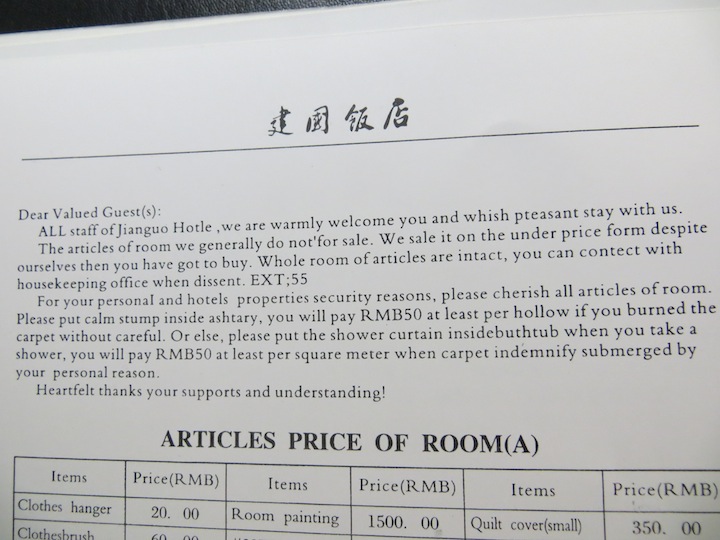
I do not know what kind of rowdy people visit this hotel, but there is a very strict warning greeting you, with a price list. They are not in the business of selling these things, but will charge you if any are missing when you leave. In addition to the usual bathrobe (300 yuan, or about $50) and pillows (¥260), the list is a complete inventory of the room. A coffee cup will cost you ¥30, but the laundry bag can be pilfered for a mere ¥5. I am not entirely sure what the propogandist billfold is, but if it goes missing, it will cost ¥350, and the casket--which I definitely have not seen--is a quick ¥75. In case you are interested in the bathtub, it goes for ¥4500.

I will, as the directions instruct, "cherish all articles of room" during my stay, and just to be safe, will not use the notepad, lest I get charged ¥25 for it.
ALL staff of Jianguo Hotle, we are warmly welcome you and whish pteasant stay with us.
The articles of room we generally do not for sale.  We sale it on the under price form despite ourselves then you have got to buy.  Whole room of articles are intact, you can contect with housekeeping office when dissent.  EXT;55
For your personal and hotels properties security reasons, please cherish all articles of room.  Please put calm stump inside ashtary, you will pay RMB50 at least per hollow if you burned the carpet without careful.  Or else, please put the shower curtain insidebuthtub when you take a shower, you will pay RMB50 at least per square meter when carpet indemnify submerged by your personal reason.
Heartfelt thanks your supports and understanding!
I would, however, like to be able to use the internet, since I lugged my computer with me to catch up on blog posts before all of these sites run together. I thought I had signed on properly, but couldn't bring up my email or the blog. I had been told the internet only worked in the lobby, so I headed down to see. The front desk lady said it was free in the room (nicer hotels usually charge for internet). "Please go back up to the room and I will call." I assumed someone would call me on the phone and talk me through it, but soon there was a knock on the door and a woman who spoke not one word of English was standing outside, looking at a complete loss. When I finally got her to come in to the room, she fiddled with the ethernet cable, which had no effect , even after I turned off the wireless. She called the front desk, who sent up another person, better dressed, who was equally unsuccessful. His diagnosis was the internet did not work in my room, and the decision was made to move me to another room. A third person arrived, with a key card.

Since I am sharing a room, this was not a workable strategy. I tried to gesture: two beds, two suitcases, two people, two keys. Another call to the front desk to translate. No problem, they can get a new key for the roommate when she arrives. (She was, in fact, next door all night. Sleeping on the floor is preferable to sleeping with an old person.) I was pretty sure the problem did not lie with the room, so I gestured that we would take only the computer to the new room until we found out.

Score one for the old person. Although the hotel had hosted as SAS group of 60 the night before, evidently no one raised this question with them. Or they are just making a show of being helpful? In any event, the change of room did not improve matters and a third person was dispatched. This one was able to discover that sites he frequents work, and we concluded reluctantly that the internet provider is blocking google and blogger (also a google site). Why these sites are not blocked in Shanghai, I don't know. I also don't know how I can get my mail from google through the Apple mail client, but I can. So I can post from my mail, but not with attachments.

for pictures, you will have to wait. Check back! I have taken 1000 pictures in just three ports. Monster slide show when I get back.


I will post some pictures as internet permits. For now, appreciate the power of the written word.

The People Stand Guard

Hello from Xi'an, in the People's Republic of China. This is the home of the famous terra cotta warriors, the grave goods of Emperor Qin. It is a fascinating site/sight.

Emperor Qin had the idea, as so many do, that he should be attended, in death as in life, by his loyal followers. He had worked very hard to ensure his safety and well being in life and he was prepared to have others ensure it in death. One of his aides, however, suggested that men of clay would do just as well as men who only had feet thereof. In the ten years before his death, he commissioned 8000 of them. The ultimate set of toy soldiers.


The Emperor's grave site has not been excavated. It is approximately the size of Macau, and the Chinese have not yet figured out how to build a structure that large without internal support poles. By comparison, the terra cotta warriors museum is tiny, more like an airplane hangar. Or three.

The warriors stand where they were found in 1974, by some farmers digging a well. Lost the farm, gained international fame, riches, and a new job signing books. The farmer, in his 80s now, comes to the museum daily and signs books. (No photos, please.)

From the outside, the buildings look very museumlike. Inside, however, they are architectural digs. Pit #1 has rows and rows of warriors standing in formation, each carved with amazing detail. Rows of unarmed men in the front, to catch the brunt of the attack, followed by men in armor, carrying spears, bows and arrows, and other weapons. (The weapons have all been looted, leaving them looking a bit like action figures missing their accessories.) There are horses, too, although their chariots are gone.

Shortly after the emperor was entombed, the site was attacked, and the warriors turned out to be completely ineffective at maintaining the peace after all. They were disarmed, their heads knocked off, the chariots burned. Pit #2 shows the dig in progress, broken warriors strewn about as the painstaking process of fitting the pieces back together proceeds.

No work was in progress today. This is the off season, and the lack of visitors make the employees of the gift shop eager to make a sale, even to bargain with you. They'll pack and ship a warrior to your door, no problem. Buy in the museum store and we guarantee the quality. I resisted the temptation of a warrior to stand guard over my garden. Wouldn't he miss his friends?

Sunday, February 3, 2013

Askakusa Adventure


Although I am posting this from Shanghai, this post is about January 29 in Tokyo.

We are encouraged to engage in the lives of the people we meet in the countries we visit, but I found this was very hard to do while my language is limited to thank you and goodbye.  Although goodhearted people helped me with directions and subway machines, we accomplished this with pointing rather than words.  So, I am largely an observer here.

Although Yoshiko kindly made an itinerary for me again today, I spent almost the entire day in Asakusa.  Here I found shopping and shrines and shopping hard by shrines and where the rich people live hard by the people who sell napkins to restaurants.  I saw the best (and worst) of Japanese art.  I watched school children and gamblers and shopkeepers and tourists.  I reunited a baby with his shoe and directed an Indian to his native cuisine and got so lost I wandered right off the map onto another page.  That's when I decided to come home.


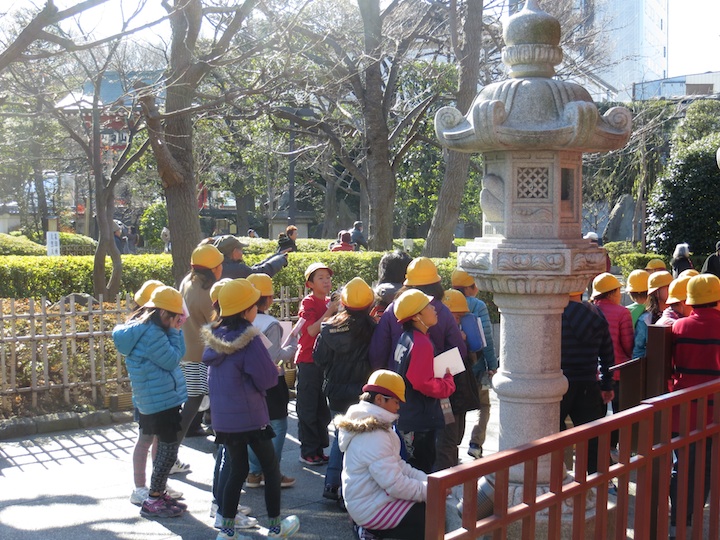
The Sensoji temple at Asakusa was very busy today.  It was closed to all but members, so I couldn't go inside.  Outside, there was a brisk business in fortunes.  You could buy a specific fortune (see Oh, man:  omen) or you could buy incense to burn and then waft the smoke towards you.  There were candles to buy for prayers, and there was the resounding clink of coins simply thrown into a large pit.  Several school groups were there and I really enjoyed watching the children zooming around.  Japanese children have the reputation of being very pressured from an early age by their rigorous education, but these kids were loosely organized, to put it generously.  The boys were roughhousing, the girls were straggling, and the teacher was not trying very hard to keep them together.  More party than field trip. One little girl was fascinated by me; I caught her eye several times. A little boy of about 8 tried out his best "Hallo" on me.  It occurred to me he probably knows more English than I will ever know of Japanese.

Each school group has a distinctive uniform, most noticeably the hats and backpacks.  Because they're all wearing winter coats, all you see here are the bright yellow hats.  Adorable!

Even in the most crowded place, you can find a little solitude if you head for the less famous spaces.  When you have a terrible sense of direction, you get lost a lot, but a bonus is that you find those quiet spaces.  At Sensoji, I found a little garden and also a shrine with a bench and table where I ate my lunch.  Then, off to the next adventure!

Shanghaied


I took a Semester at Sea tour our first day in Shanghai, a great way to see a lot of things in a short time. Packed into one day, we went to the Jade Buddhist Temple, the Yuyuan Garden, the Shanghai Museum, and an acrobatics performance, as well as lunch and dinner at fancy Chinese restaurants.  Tomorrow, I head off to X’ian, the city where the terra cotta warriors were discovered.

China is not as difficult as we were led to believe.  As in Japan, lots of the signs are in English.  Vendors on the street will take US dollars, and the places we went all take American credit cards, so we had no trouble at all spending money foolishly.  I found an American quarter on the ground, but wound up giving it away.  Our tour guide knew all the good bathrooms, with “western” toilets and toilet paper.  One more day safe from squatting.


The Jade Temple is named for two large Buddhas carved from white jade.  Chinese Buddhists worship quite a cast of characters.  Including the head guy Buddha, there are secondary Buddhas, including a woman Buddha, the four Heavenly Kings, and a whole host of Buddha’s in training, who were once people or sometimes evil spirits who have been enlightened.  In every temple, there is the Hall of the Heavenly Kings, two of them quite fierce for dispatching enemies and two very happy, representing the finer things in life.  The threshold of the temple is high, we were told, because evil spirits are always very short and this keeps them out.  We got introduced to some of the minor cast of characters, like the very bad lady who used to eat children, until the Buddhas took away her own child and she developed some empathy.  Now she is protector of the children.  (Would you trust her folks, really?  It’s not that easy to break a bad habit, especially one involving food.)

I also liked the practicality of the lady Buddha.  She is, our guide told us, the only female Buddha.  I gather she has taken this form in a genius marketing strategy to win converts.  Most of the Chinese Buddhists are women, and somewhere along the line, Buddha felt that taking the form of a woman would be helpful in reaching out to women, who had the most leisure time for coming to the temples.  As the lone gal, she is very popular and had her own building on the temple grounds.  She is also pictured with her 53 disciples, in contrast to the boys, who tend to appear alone.  So she’s a mentor, too.

You have to pay to get into Jade Temple, and you have to pay extra to see the actual jade Buddhas.  But if you pony up, you can also enjoy a convivial cup of Buddha tea as well as special shopping opportunities.

There are ten varieties of Buddha tea, good for whatever ails you.  Clean your liver, lose weight, alleviate arthritis, lower your blood pressure, cure cancer, balance your metabolism, help you sleep, boost energy, reverse constipation.  You can also drink them in combination if you have more than one issue that needs to be addressed.  We tried #2 (liver detox and weight loss), #5 (relaxation, energy, sleeping), and 2, 5, 8 in combination (add balance metabolism, constipation, indigestion).  Also available for purchase, cups to drink your tea in and pots to brew it in.

The Chinese did not get to their place in the world economy without being savvy in the ways of business.  The temple is full of opportunities to purchase souvenirs (credit cards happily accepted), to donate to the monks, or buy fortunes and blessings.  You can burn candles and incense, or throw money at receptacles placed just out of reach, much like a carnival game.  There was a fair bit of money just lying around on the ground, too.  En route to the temple, we encountered dozens of street vendors eager to sell us postcards, toys, and roller skates that light up (latest fad:  they are everywhere).

Our tour guide, Susie, brought us through the crowded streets to the Silk Works, a convenient meeting place.  The Silk Works is a display showing the life cycle of the silk worm and a large showroom of silk scarves, clothing, and bedding.  Also, a convenient meeting place.  I had just enough time to buy a silk comforter, as did several other people on our tour.  Susie is very good at her job.